Building a health financing model that is humane, comprehensive and viable.
At Sampada we are building a bottom-up model of health financing that understands the complexity of lending for health in retail, and crafts a client journey that understands the risks on ground and builds the rails to manage them — and it does so with its heart in the right place.
Our partnership with Uplift Mutuals brings the health focus into the model, where medical underwriting, navigation support, follow-up and access to primary care are all woven into a seamless business-with-a-heart design.
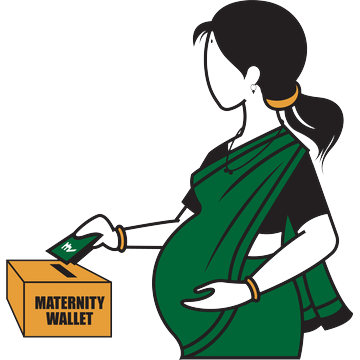
Our specially designed wallets bring savings for specific health events with prevention integrated into them, and our partnership for mutual health microinsurance shows that we want to build viable lending and not a debt trap.
THE FIVE HUBS
Kalyan-DombivliOCT 2023
Janta Vasahat, PuneMAR 2024
Mumbai EastMAR 2024
Navi Mumbai2025
Mumbai Harbour2026
KALYAN-DOMBIVLI INCLUDES ULHASNAGAR EACH HUB SERVES ROUGHLY 50,000 HOUSEHOLDS 3 FINANCIAL PRODUCTS · 7 HEALTH SERVICES 18 POSTS · 12.6 FTE · OF WHICH 1.6 FTE DOCTORS
IN ONE LINEThe step that protects the patient is the step that makes the loan repayable.
HOW IT IS RUN
Community-centric. Professionally managed.
MEMBERSHIP
Every member takes shares and holds a vote. Borrowers and shareholders are the same people.
WRITTEN PROCESS
Origination, collections and closure each run on a numbered SOP, versioned and reviewed six-monthly.
SEGREGATED DUTIES
Clinical, credit, quality check and disbursement sit with four different teams.
REGISTERED
2017, at Thakurli East, Thane. Reg. TNA/DDR/RSR/CR-1747/2017.
Comprehensive health financing
THREE PRODUCTS, ONE MEMBERSHIP, ONE COUNTER
A household in a health crisis needs three different things, often in the same week: money it has already put aside, money it can borrow against a bill, and cover so the next event does not start the cycle again. A member gets all three on one membership, at one counter, from people she already knows.
PRODUCT 01 · SAVINGS
Maternity Wallets
4–7.5% p.a. to the saver
Goal-based doorstep savings for expectant mothers and mothers of children under five, to carry the cost of antenatal care, a safe delivery, post-natal care and the child's first years. Every wallet opens with a written month-by-month financial plan and a first check-up with the hub doctor.
RATE BY TENURE4–7.5%
COLLECTIONDOORSTEP
OPENED, FY 25-26792
HELD IN WALLETS₹30 L
PRODUCT 02 · CREDIT
Emergency Health Loans
9–21% a year, reducing
For planned and unplanned treatment, typically sanctioned within a day of the file clearing. The alternative in these settlements is a moneylender at 120% a year unsecured, or 30–60% against pledged gold. Repayment is monthly, on a date the member sets herself.
UNSECURED · ₹5,000 – ₹30,000
The common urgent need. Up to ₹40,000 for a member taking a repeat loan. One guarantor up to ₹15,000, two above it. No collateral.
GOLD-SECURED · ₹30,000+ TO ₹5 L
Critical illness, surgery, cancer, repeated treatment cycles — and households a bureau cannot see: new migrants and tenants. A high share of capital disbursed.
RATE9–21% A YEAR, REDUCING
DISBURSED, FY 25-26874 · ₹3.12 CR
PAR 30+1.25%
PRODUCT 03 · COVER
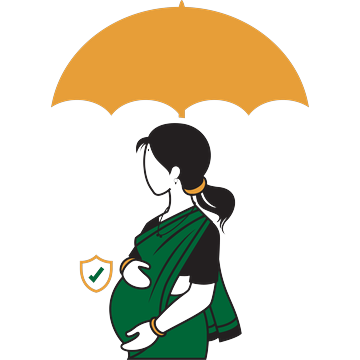
Health Mutual Insurance
1,500+ protected
Community-held cover carried with Uplift Mutuals and embedded with the medical loan, so protection begins during the crisis that brought the household in rather than after it. Claims are decided by a Benefit Management Committee of elected women members. For most members it is their first insurance of any kind.
CARRIED BYUPLIFT MUTUALS
CLAIMS DECIDED BYMEMBER COMMITTEE
PROTECTED, FY 25-261,500+
EMBEDDED WITH LOANYES
FIGURE 1
How a household arrives, and why that matters to the risk
Who meets a household first decides what we know about them before money is discussed. Someone who came in through a health camp or a health worker’s visit already has a health record with us. Someone who answered a pamphlet does not. We check both the same way, but they do not start from the same place.
FIGURE 2
Seven gates between an enquiry and a disbursement
The doctor’s check does not replace the credit check. It sits inside it. The bureau check happens before any doctor sees the file, and the household visit happens after. Three different people can stop a loan that has already passed every earlier step.
24 MONTHS OF LEARNING
3 underwriting controls
Lending for health in retail was never easy. Our learning curve of 24 months has taught us that credit underwriting alone won’t work for unsecured loans to individuals.
We improved our diligence by bringing in medical underwriting to qualify for the lending, where we evaluate the medical costs similar to an insurance claim to understand if the costs are within range.
Then comes the health loan training through the home visit, where the terms and conditions of the lending are not only verbally explained to all the loan stakeholders but also given in writing to the client, to maintain transparency and avoid mis-selling.
Credit Score Check, Medical Underwriting and Home Visit are the three checks that have made lending — and consequently repayment — possible.
HOW MANY WE SAY NO TO
APPLICATIONS RECEIVED879
LOANS APPROVED310
APPROVAL RATE35%
PERIODAPR–JUN 2026
About two in three applications do not become loans. Most were not turned away. They were sent to a government hospital, helped to claim a scheme they were already entitled to, or given a lower price we had agreed with a hospital — and the family paid nothing.
AGAINST WHAT WE PLANNED FOR
Our business plan expected to lose 3% of the book, rising to 5% by year four. So far it is 1.25%.
HOW WE ARRIVED AT THIS
There is no one else lending this way, so there was no playbook to follow.
No bank, no NBFC and no microfinance lender we know of writes unsecured credit against a medical bill for these households. That means there is no standard we could copy and no one to benchmark against. Every check on this page came from something that went wrong, or nearly did, and was then written into the procedure.
That is also why the procedures carry version numbers and a six-month review. We expect to keep changing them. What is written here is where we have reached after twenty-four months, not where we think we will stop.
Where the risk goes
FOUR REDUCTIONS, APPLIED IN ORDER
Most of these loans have nothing pledged against them, so there is nothing to take back. We cannot hand the risk to anyone else either. What we can do is bring it down in stages, so that what reaches the book is only what we could not take out earlier.
REDUCTION 01
Less is lent in the first place
A second doctor, not the one at the hub, checks whether the treatment is needed and whether the price is fair, and says how much the loan should be. Getting the hospital price down, or getting a government scheme to pay, means we lend less or nothing.
REDUCTION 02
The household is judged separately
Credit record, income, what the family owns, and what the officer sees at the house. The Branch Manager can refuse the loan on repayment ability alone, however strong the medical case is.
REDUCTION 03
Cash and instruments sit behind it
Compulsory savings accumulate through the tenure and can be transferred against the outstanding at closure. Two post-dated cheques are held on the disbursement account. Guarantors are verified at their own homes — one for loans up to ₹15,000, living within about 300 metres; two above that.
COMPULSORY SAVINGS₹14.8 L
AGAINST A BOOK OF₹1.98 CR
RATIO · DERIVED7.5%
REDUCTION 04
A second illness does not become a default
Insurance comes with the loan, so if someone is admitted again while the loan is running, there is cover instead of a missed payment. When illness is the reason for a delay, our team helps the family put in the claim.
WHAT IS LEFT
The risk is managed, not removed.
When the person who earns is in hospital, the money coming in falls and the money going out rises in the same week. No process changes that. Some loans will go bad. Some members will need a late charge waived or a new date agreed, and our rules allow for both, decided by the Chairperson and written down.
Our business plan expected to lose 3% of the book, rising to 5% by year four. So far the four steps above have held it to 1.25% at 30 days. That difference is what the doctor’s step has bought us so far. It is a number we have to keep earning, not one we can assume.
FIGURE 3
How 1.25% is actually held
We start before the date, not after it. The member picks her own EMI date when she signs, between the 1st and the 15th, and it stays the same for the whole loan. If she misses it, someone is at her door the same day — not to press her, but to find out why and write it down.
THE OTHER HALF OF THE HUB
Seven health services run alongside the lending — teleconsultation and health camps, a 24×7 doctor-led helpline, navigation, discounted medicines and investigations, a negotiated provider network, access to public entitlements and chronic disease management. All of them are run by Uplift Mutuals, who have worked in these settlements since 2004, and all of them write into the same member record we make the loan decision from.
Dashrath Bhardwaj, 39, tiffin service, household income ₹18,000 a month, admitted for aspiration of a liver abscess. Note step 2: the public route was tried first, and it did not work. That is the part a brochure would leave out.
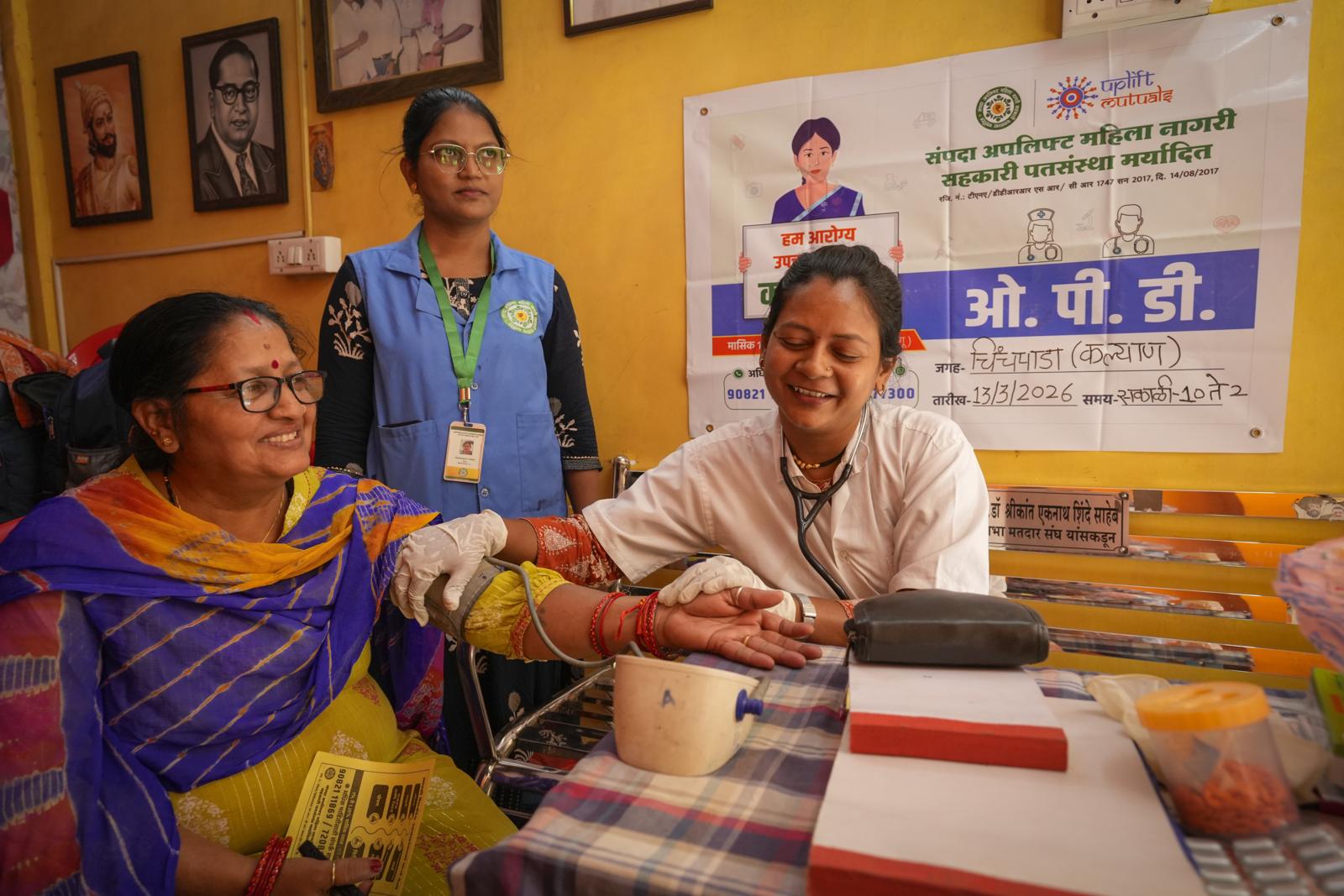
A DOCTOR'S CONSULTATION UNDER THE COOPERATIVE'S BANNER
Who is in the room
Eighteen posts across fourteen roles, about 12.6 full-time equivalents. Four posts are doctors — hub, helpline, triage and provider-networking — totalling 1.6 FTE of physician time per hub, provided through Uplift Mutuals. Clinical underwriting therefore costs the cooperative under two doctor-equivalents per hub.
Role
FTE
Posts
Health Financing Officers
100%
4
Community Health Workers
100%
2
Encoders
100%
2
Health Wallets / Savings Officer
100%
1
Hub Doctor
100%
1
Hub Manager
100%
1
Call Centre Officer
25%
1
Medical Helpline Doctor
20%
1
Medical Triage Doctor
20%
1
Provider Networking Doctor
20%
1
Area Manager — Emergency Medical Loans
20%
1
Area Manager — Wallets & Insurance
20%
1
Accounts Officer
20%
1
Software Manager
10%
1
Total per hub
12.6
18
FTE means full-time equivalent. The hub has eighteen posts, but several are part-time or shared across hubs — a Health Financing Officer is at the hub full time, the Software Manager for a tenth of the week — so eighteen posts come to about 12.6 people’s worth of time.
WHY THE HUB IS THE UNIT
None of the steps on this page work on their own. They work because they happen in one place.
A lender with no doctor cannot check an illness. A doctor with no loan book cannot help when the family has no money. A helpline with neither can only give advice. The hub works because savings, credit, cover and care are at the same counter, written on the same member file, and handled by people who see the same families week after week.
It is also why we only open where Uplift Mutuals has already been working for years. The hub opens where people already need it, and where they already know the doctor.